
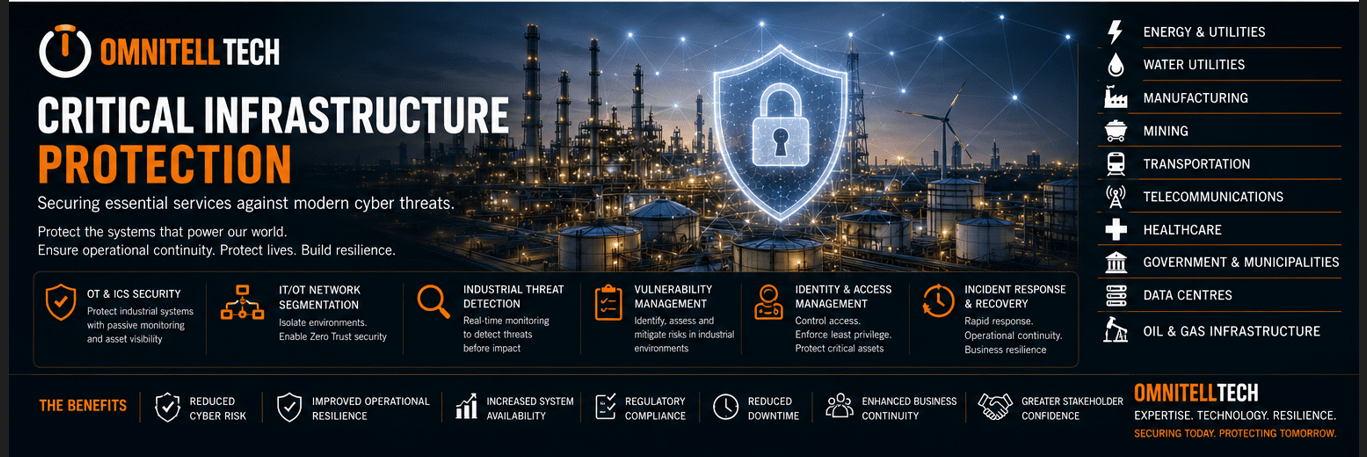
Critical Infrastructure Protection (CIP) has become one of the most important priorities for organisations operating in energy, water, manufacturing, transportation, healthcare, telecommunications, mining, and government sectors. As Operational Technology (OT), Industrial Control Systems (ICS), and Internet of Things (IoT) devices become increasingly connected, cyber threats can now cause physical disruption, operational downtime, financial loss, and public safety risks.
Modern cyberattacks no longer target only business data—they target industrial operations. Ransomware, supply chain attacks, insider threats, and sophisticated nation-state actors increasingly focus on critical infrastructure because of its strategic importance. Organisations need specialised security that protects both Information Technology (IT) and Operational Technology (OT) environments without disrupting operations. Omnitell Tech delivers this through its comprehensive Critical Infrastructure Protection services.
What is Critical Infrastructure Protection?
Critical Infrastructure Protection (CIP) refers to the technologies, policies, processes, and security controls used to safeguard systems that provide essential services. These include:
- Electrical power grids
- Water treatment and distribution
- Manufacturing facilities
- Mining operations
- Oil and gas infrastructure
- Transportation networks
- Telecommunications
- Healthcare facilities
- Government infrastructure
- Smart cities and municipalities
- Data centres
The objective is to ensure these systems remain available, resilient, and protected from cyber threats, natural disasters, operational failures, and insider risks.
Why Critical Infrastructure is Under Increasing Attack
Digital transformation has connected industrial equipment to corporate networks, cloud platforms, and remote monitoring systems. While this improves efficiency and productivity, it also creates new attack surfaces.
Today’s threats include:
- Ransomware targeting industrial operations
- Remote exploitation of SCADA systems
- OT malware
- Industrial espionage
- Supply chain attacks
- Insider threats
- IoT vulnerabilities
- Distributed Denial of Service (DDoS) attacks
- Zero-day exploits
- Advanced Persistent Threats (APTs)
Unlike traditional IT incidents, attacks on industrial systems can stop production, interrupt essential services, damage equipment, or even endanger human lives. Modern Critical Infrastructure Protection requires specialised security designed specifically for OT environments.
Key Components of Critical Infrastructure Protection
1. OT and ICS Security
Operational Technology controls industrial processes such as manufacturing equipment, pumps, turbines, substations, and production lines. Protecting these environments requires passive monitoring and specialised cybersecurity tools that do not interrupt operations.
Benefits include:
- Continuous visibility
- Asset discovery
- Vulnerability identification
- Safe industrial monitoring
- Reduced operational risk
2. IT and OT Network Segmentation
Separating corporate IT networks from industrial OT systems significantly reduces the risk of attackers moving laterally across environments.
Network segmentation enables:
- Zero Trust architecture
- Secure remote access
- Controlled communication
- Reduced attack surface
- Improved compliance
3. Industrial Threat Detection
Modern Critical Infrastructure Protection relies on continuous monitoring rather than periodic assessments.
Advanced monitoring identifies:
- Unusual network traffic
- Suspicious user activity
- Malware infections
- Configuration changes
- Policy violations
- Industrial protocol anomalies
Real-time monitoring enables rapid detection before attacks disrupt operations.
4. Vulnerability Management
Many industrial systems operate for decades and cannot be patched frequently.
A comprehensive vulnerability management programme includes:
- Passive vulnerability assessments
- Risk prioritisation
- Security hardening
- Patch planning
- Configuration reviews
- Asset inventory management
5. Identity and Access Management
Strong identity management prevents unauthorised access to critical systems.
Best practices include:
- Multi-factor authentication
- Role-based access control
- Least privilege policies
- Privileged Access Management (PAM)
- Secure remote vendor access
6. Incident Response and Recovery
Industrial incident response differs significantly from standard IT response.
A specialised OT incident response plan focuses on:
- Human safety
- Operational continuity
- Rapid containment
- Industrial recovery
- Business continuity
- Disaster recovery
Industries That Benefit from Critical Infrastructure Protection
Manufacturing
Protect production lines, robotics, PLCs, SCADA systems, and industrial automation against cyberattacks that can halt manufacturing.
Energy and Utilities
Secure power generation, substations, renewable energy systems, smart grids, and electrical distribution networks.
Water Utilities
Protect water treatment facilities, pumping stations, reservoirs, and distribution infrastructure from cyber threats.
Mining
Secure autonomous equipment, processing plants, conveyor systems, and operational technology environments.
Government and Municipalities
Protect citizen services, transport infrastructure, emergency systems, public utilities, and municipal networks.
Healthcare
Safeguard hospitals, medical devices, patient systems, and critical healthcare infrastructure.
Benefits of Modern Critical Infrastructure Protection
Organisations implementing a mature Critical Infrastructure Protection strategy gain significant operational advantages.
These include:
- Reduced cyber risk
- Improved operational resilience
- Increased system availability
- Regulatory compliance
- Better asset visibility
- Reduced downtime
- Faster incident response
- Enhanced business continuity
- Protection of industrial control systems
- Greater stakeholder confidence
Emerging Technologies Transforming Critical Infrastructure Protection
Technology continues to reshape industrial cybersecurity.
Modern organisations increasingly leverage:
- Artificial Intelligence (AI)
- Machine Learning
- Predictive analytics
- Security Information and Event Management (SIEM)
- Extended Detection and Response (XDR)
- Zero Trust Architecture
- Industrial IoT security
- Digital twins
- Threat intelligence platforms
AI-powered monitoring can identify unusual industrial behaviour long before human operators detect potential failures or cyber incidents.
Why Choose Omnitell Tech?
Omnitell Tech combines cybersecurity expertise with deep knowledge of industrial environments, helping organisations secure both IT and OT infrastructures through integrated protection strategies. Their Critical Infrastructure Protection services include:
- OT and ICS Security Assessments
- IT/OT Network Segmentation
- 24/7 Passive OT Threat Monitoring
- Industrial Endpoint Hardening
- Secure IoT Deployment
- Industrial Incident Response
- Compliance support
- Continuous monitoring and risk management
Unlike traditional IT security providers, Omnitell Tech understands that industrial environments require non-disruptive security approaches that prioritise operational continuity, safety, and uptime. Their solutions are designed to protect critical assets while supporting digital transformation initiatives across manufacturing, utilities, municipalities, mining, and other essential industries.
Future-Proof Your Critical Infrastructure
As cyber threats continue to evolve, protecting critical infrastructure is no longer optional. Organisations must adopt proactive cybersecurity strategies that secure industrial operations without compromising performance.
Whether you’re operating a manufacturing plant, utility network, municipal service, mining operation, or smart infrastructure environment, investing in comprehensive Critical Infrastructure Protection reduces operational risk, improves resilience, and ensures business continuity.
Omnitell Tech delivers end-to-end Critical Infrastructure Protection solutions that help organisations confidently embrace digital transformation while protecting the systems that matter most.
Frequently Asked Questions (FAQs)
What is Critical Infrastructure Protection (CIP)?
Critical Infrastructure Protection is the process of securing essential systems such as power, water, transportation, manufacturing, healthcare, and government infrastructure against cyber threats and operational disruptions.
What industries require Critical Infrastructure Protection?
Industries including manufacturing, utilities, mining, healthcare, transportation, government, telecommunications, and oil and gas all require specialised Critical Infrastructure Protection.
Why is OT security different from IT security?
Operational Technology controls physical processes and equipment. Traditional IT security tools can disrupt industrial operations, so OT environments require passive, specialised security solutions.
What is IT/OT convergence?
IT/OT convergence refers to connecting operational technology with business IT systems to improve efficiency and data visibility. While beneficial, it also increases cybersecurity risks that require specialised protection.
How does Omnitell Tech help organisations protect critical infrastructure?
Omnitell Tech provides OT security assessments, industrial threat monitoring, network segmentation, endpoint hardening, secure IoT deployments, incident response planning, and continuous monitoring to protect critical infrastructure while maintaining operational uptime.